2026 Top Acrylic Hinges Types for Global Buyers
Choosing the right acrylic hinges in 2026 requires more than comparing shapes, colors, or prices. Global buyers now evaluate transparency, load capacity, corrosion resistance, installation accuracy, and long-term reliability. A hinge may look elegant on a clear display case, yet fail when the door becomes heavier or misaligned.
This guide introduces the main acrylic hinge types used for display cabinets, retail fixtures, furniture, signage, and light commercial projects. It examines clear acrylic hinges, reinforced designs, removable hinges, concealed options, and metal-acrylic combinations. Each type serves a different purpose. Small transparent hinges suit lightweight boxes. Reinforced models perform better on frequently opened doors. Concealed hinges create a cleaner appearance, but they often demand tighter drilling tolerances. Small details matter.
Practical selection should begin with the panel thickness, door weight, opening angle, and expected usage. Buyers should also request material specifications, dimensional drawings, test information, and consistent samples from suppliers. Experience shows that a beautiful prototype does not always represent stable mass production. Color, hole position, and screw fit can change between batches. That risk deserves attention.
Reliable sourcing also requires checking packaging quality, inspection procedures, communication speed, and after-sales support. Regional climate may influence performance, especially in humid coastal markets or locations with strong sunlight. No single hinge fits every application. Some recommendations remain conditional, because real projects include imperfect drilling, uneven frames, and rushed installation. Careful testing is still the most dependable step.
Acrylic Hinges: Definition, Structure, and Core Functions
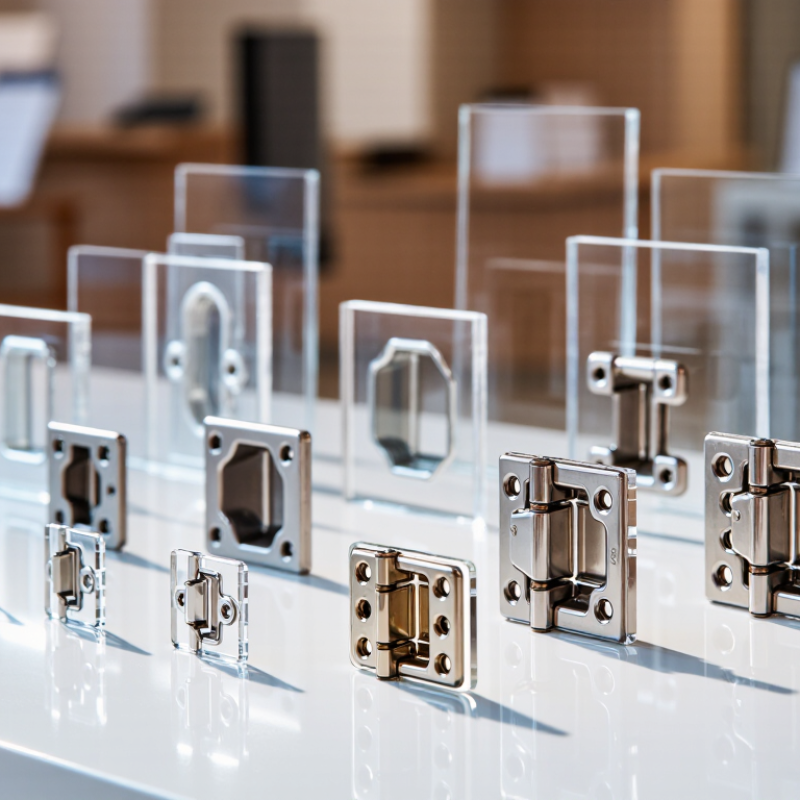
Acrylic hinges are transparent joining components used to connect two panels while allowing controlled movement. They commonly appear in display cases, light covers, cabinets, and compact equipment enclosures. Their clear appearance preserves visual continuity. That matters in retail and interior applications.
Most designs use a flexible acrylic strip, drilled mounting holes, and a hinge barrel or folded joint. Some models are machined from one acrylic sheet, creating an integral living hinge. Others combine acrylic leaves with a separate pin. The structure determines movement, load capacity, and service life. Accurate hole spacing is essential. Small installation errors can create stress around the fasteners.
The core function is simple: support opening and closing without blocking the panel view. A suitable hinge also distributes force across the joint and maintains alignment. Clear acrylic can resist moisture and moderate ultraviolet exposure, but it is not unbreakable. Excessive tightening may cause cracks. Solvent contact can create fine crazing that appears days later. That detail is often missed.
For global buyers, check panel weight, opening angle, temperature range, and expected cycle count. Test a sample before approving bulk production. In practical fitting work, a hinge may look strong yet flex noticeably under uneven loads. That is a useful warning, not a failure. Clear hardware still needs conservative engineering.
Main Types of Acrylic Hinges for Global Buyers
Acrylic hinges for global buyers usually fall into several practical types. Flat acrylic hinges suit light display doors and small cabinet panels. Their transparent leaves keep the joint visually quiet. Butt hinges offer stronger alignment for thicker acrylic sheets. They work well when the door needs a clean opening action.
Continuous, or piano-style, hinges spread weight along the full panel edge. This design reduces stress around individual screw holes. Corner hinges support 90-degree box structures, such as display cases and protective covers. Lift-off hinges allow quick panel removal during cleaning or maintenance. Friction hinges are useful when the door must stay open at a chosen angle.
Material choice deserves careful attention. Clear plastic hinges match transparent panels, but they may scratch or weaken under repeated impact. Metal hinges provide better load resistance, although they can interrupt a seamless appearance. Check the acrylic thickness, screw size, hole spacing, opening angle, and expected cycle count. Small details matter. Outdoor buyers should also ask about ultraviolet exposure and temperature changes. Installation experience shows that over-tightening screws can create stress cracks near drilled holes. I once treated “clear” as equal to “invisible,” which was not fully correct; reflections can still reveal the hinge. Suppliers should provide drawings, load guidance, sample testing, and consistent dimensional records before bulk purchasing.
Material, Load Capacity, and Performance Comparison
2026 Top Acrylic Hinges Types for Global Buyers
Material, Load Capacity, and Performance Comparison
Acrylic hinges suit display cases, lightweight doors, cabinets, and transparent enclosures. Their clear finish preserves visibility around the joint. However, clarity does not equal strength.
Standard acrylic butt hinges work well for small panels and low opening frequency. Continuous acrylic hinges spread force along the panel edge. They can reduce local stress when installation is accurate. Lift-off designs improve maintenance access, but their removable joint may loosen under vibration. Acrylic is rigid and attractive, yet it can crack near drilled holes. Rounded holes, correct washers, and moderate tightening matter.
Load capacity depends on hinge length, panel weight, screw spacing, material thickness, and opening angle. Static loads are easier to manage than repeated movement. A small door may feel light but create high torque at the hinge line. I recommend testing the complete assembly, not the hinge alone. Check sag, whitening, edge cracks, and screw movement after repeated cycles.
Temperature and sunlight also affect performance. Standard acrylic may become less reliable under impact or harsh outdoor exposure. For demanding applications, compare acrylic with polycarbonate or corrosion-resistant metal hinges. These alternatives may offer better toughness, although they change the visual design. My practical mistake was judging capacity by appearance. A thicker hinge looked safer, but weak mounting points failed first. Buyers should request dimensional drawings, tested load data, and installation guidance before placing large orders.
2026 Top Acrylic Hinges Types for Global Buyers
Material, indicative static load capacity, and operating-temperature comparison for common transparent-panel hinge constructions.
The load figures represent indicative engineering benchmarks for a 100 mm hinge supporting an evenly distributed static load. Polycarbonate offers higher impact resistance than PMMA acrylic, POM is suitable for low-friction moving parts, and 304 stainless steel provides the highest load and temperature capability when transparency is not the primary requirement. Actual performance depends on hinge geometry, fasteners, panel thickness, installation method, and safety factor.
Selection Criteria for Different Applications and Environments
2026 Top Acrylic Hinges Types for Global Buyers
For global buyers, acrylic hinges should be selected by environment, load, and movement frequency, not appearance alone. Clear cast acrylic hinges suit display cabinets, laboratory covers, and lightweight interior panels. Extruded acrylic versions may reduce cost, but dimensional stability requires closer checking. Acrylic is light. It is not unbreakable.
For outdoor use, choose UV-stabilized material and test color change, haze, and cracking. ISO 4892-2 provides a recognized method for accelerated weathering evaluation. In humid rooms, check moisture exposure, screw compatibility, and stress around drilled holes. For frequent opening, compare cycle-test results rather than relying on static load ratings. ASTM D1003 testing can help assess optical haze in transparent applications. Grand View Research’s 2024 acrylic resin market report forecasts roughly 5% annual growth through 2030, reflecting wider demand but not guaranteeing hinge quality. Market forecasts vary, and that deserves caution.
Tips: Match hinge thickness with panel thickness. Leave clearance for thermal expansion. Avoid over-tightening screws. Test a sample for 500 to 1,000 cycles before bulk purchasing. For chemical areas, expose samples to the actual cleaner, because laboratory data can miss real cleaning habits. A beautiful hinge may still be the wrong hinge.
2026 Top Acrylic Hinges Types for Global Buyers - Selection Criteria for Different Applications and Environments
Practical comparison of acrylic hinge constructions, materials, operating conditions, and application suitability. Values are typical design guidance and should be verified through project testing.
| Hinge Type | Typical Acrylic Construction | Typical Size Range | Indicative Door or Panel Load | Opening Range | Recommended Environment | Main Advantages | Main Limitations | Best-Fit Applications | Buyer Selection Priority |
|---|---|---|---|---|---|---|---|---|---|
| Clear Acrylic Butt Hinge | Transparent cast or extruded PMMA leaves with a central pin, commonly used in pairs. | Leaf width: 20–50 mm Length: 40–100 mm Material thickness: 3–8 mm |
Light panels, generally up to about 3–8 kg per pair when properly mounted. | Approximately 90°–180°, depending on geometry and clearance. | Indoor retail, display, office, laboratory, and clean protected areas. | Minimal visual obstruction, easy inspection, clean appearance. | PMMA can crack under impact, over-tightening, or sharp drilled holes. | Display cases, acrylic cabinets, signage covers, and small access doors. | Transparency, edge quality, screw-hole design, and panel weight. |
| Continuous Acrylic Piano Hinge | Long extruded acrylic leaves with a continuous knuckle and removable or fixed pin. | Leaf width: 20–40 mm Length: 100–1200 mm Material thickness: 3–6 mm |
Suitable for long, lightweight panels; load depends strongly on fastener spacing and substrate. | Approximately 90°–180°. | Indoor and sheltered installations requiring distributed support. | Reduces local stress, improves alignment, and supports long covers continuously. | Requires accurate alignment; long acrylic sections may expand and contract with temperature. | Machine guards, long display lids, equipment covers, and cabinet doors. | Length tolerance, mounting-hole spacing, pin retention, and thermal clearance. |
| Lift-Off Acrylic Hinge | Two-part clear PMMA hinge with interlocking knuckles and a removable pin or disengaging barrel. | Leaf width: 20–45 mm Length: 40–100 mm Material thickness: 4–8 mm |
Light access panels, typically up to about 2–6 kg per pair depending on panel size. | Approximately 90°–180°. | Indoor equipment and enclosures requiring frequent panel removal. | Fast tool-free or low-tool panel removal; convenient for maintenance. | Can disengage if the panel is lifted or misaligned during operation. | Inspection covers, removable guards, service panels, and exhibition structures. | Retention security, alignment, removal direction, and cycle frequency. |
| Offset Acrylic Hinge | Clear PMMA leaves with an offset barrel that moves the panel away from the frame. | Leaf width: 25–55 mm Length: 40–100 mm Offset: 5–20 mm |
Light-to-medium panels; actual capacity depends on offset distance and fastener layout. | Approximately 90°–180°. | Indoor cabinets and framed enclosures with recessed or overlapping doors. | Helps clear frame lips, gaskets, and adjacent panels during opening. | Offset increases leverage and stress at the mounting points. | Display cabinets, instrument enclosures, recessed doors, and framed boxes. | Required clearance, offset dimension, mounting strength, and door alignment. |
| Friction Acrylic Hinge | Acrylic hinge body with a friction-adjustable pin or insert that resists free movement. | Leaf width: 20–45 mm Length: 40–80 mm Material thickness: 4–8 mm |
Small lightweight lids and covers; friction torque must be matched to panel torque. | Typically 0°–180° with position holding in the rated range. | Indoor displays, control covers, point-of-sale equipment, and light instruments. | Can hold a lid or screen at an intermediate angle without a separate stay. | Friction changes with wear, contamination, temperature, and repeated cycling. | Display lids, small monitor covers, inspection windows, and protective shields. | Torque rating, adjustment method, cycle life, and resistance to dust or chemicals. |
| UV-Stabilized Acrylic Hinge | PMMA formulation or protective surface treatment designed to reduce outdoor UV-related discoloration. | Commonly based on butt, continuous, or offset designs; 40–1200 mm length. | Light panels only unless supported by a reinforced structure. | Approximately 90°–180°, depending on design. | Sheltered outdoor signage, displays, kiosks, and daylight-exposed enclosures. | Better long-term optical appearance than untreated acrylic in UV exposure. | UV stabilization does not eliminate thermal expansion, impact sensitivity, or weathering. | Outdoor display cases, covered kiosks, architectural models, and sign cabinets. | UV test data, color retention, moisture exposure, fastener corrosion, and drainage. |
| Impact-Modified Acrylic Hinge | PMMA modified with impact-resistant additives or blended acrylic materials. | Leaf width: 25–60 mm Length: 40–120 mm Material thickness: 4–10 mm |
Preferred for moderate-impact light panels; capacity requires application testing. | Approximately 90°–180°. | Public-facing indoor areas, transport interiors, workshops, and frequently handled covers. | Improved resistance to accidental knocks compared with standard acrylic. | May have lower optical clarity or different chemical resistance than clear cast PMMA. | Public displays, protective screens, service covers, and portable exhibits. | Impact test method, transparency requirement, chemical exposure, and operating temperature. |
| Frosted or Textured Acrylic Hinge | Frosted, satin, or textured acrylic surfaces used where glare reduction and visual privacy are important. | Usually follows butt or continuous hinge formats; 40–1200 mm length. | Light panels; load is generally comparable to the underlying hinge construction. | Approximately 90°–180°. | Indoor environments where glare, fingerprints, or direct visibility must be reduced. | Improves privacy and can conceal minor surface marks or fingerprints. | Texture can retain dirt and may be more difficult to clean than a polished surface. | Medical displays, office partitions, retail fixtures, and privacy covers. | Surface cleanability, optical diffusion, scratch resistance, and hinge compatibility. |
Global Purchasing, Quality Standards, and Supplier Evaluation
2026 Top Acrylic Hinges Types for Global Buyers
Global buyers often choose clear acrylic hinges for display cases, cabinets, lightweight doors, and retail fixtures. Common types include butt hinges, piano hinges, lift-off hinges, and concealed pivot hinges. Each design needs different checks.
Butt hinges suit small panels. Piano hinges spread load across longer edges. Lift-off hinges simplify maintenance, but poor alignment can create stress cracks. Acrylic is attractive, yet it is not automatically durable. PlasticsEurope’s Plastics—The Fast Facts 2024 reported global plastics production of 413.8 million tonnes in 2023. This scale increases material availability, but does not guarantee consistent PMMA quality.
Supplier Evaluation
Supplier evaluation should begin with traceable material data. Request the PMMA grade, UV-resistance evidence, dimensional tolerances, load testing, and screw-hole measurements.
ISO’s Survey of Management System Standard Certifications 2023 recorded more than 1.2 million ISO 9001 certificates worldwide. Certification is useful evidence of process control. It is not proof that every hinge will perform well.
Ask for batch records, inspection photographs, salt-spray results for metal parts, and samples from current production. Test opening cycles under realistic weight. I once trusted a perfect sample too quickly; the production batch showed uneven drilling. That mistake was avoidable.
Tips: Compare at least three suppliers using the same drawing and test method. Check carton protection, moisture control, replacement parts, and delivery records. Confirm whether “acrylic” describes the hinge body, cover, or only the panel. Small wording differences can change the purchase.
Related Posts
-
2026 Top Acrylic Hinges for Global Buyers Insights?
-

Top Uses of Flexible Plastic Tubing in Various Industries?
-
Unlocking the Benefits of PVDF Tubing: Why It’s the Future of Industrial Solutions
-
2026 Best PVC Extrusions for Global Buyers?
-
What is a Plastic Channel and How Can It Benefit Your Business?
-
Top 10 Rigid Plastic Tubing Suppliers Worldwide?