How to Choose the Right Polycarbonate Tube?
Choosing the right polycarbonate tube starts with its job, not its price. Will it carry fluid, protect wiring, guide light, or serve as a visible guard? Each use puts different demands on clarity, impact resistance, temperature tolerance, and chemical exposure. A clear tube on a workshop bench may look suitable, yet a cleaning agent or sustained heat can cloud or weaken the wrong grade. Small details matter.
The market context is growing, but growth alone does not identify the right specification. Grand View Research’s Polycarbonate Market Size, Share & Trends Analysis Report estimates the global market at about US$20.5 billion in 2023. That figure signals broad industrial use; it does not guarantee that every polycarbonate tube meets a particular application’s needs. ASTM D3935 provides a classification system for polycarbonate materials, but it is not a substitute for checking a supplier’s tube dimensions, grade, and test data.
Look closely at the wall thickness, outside diameter, tolerances, operating temperature, and exposure conditions. Ask for a technical datasheet and, where performance is critical, a sample to test under realistic conditions. Check whether the stated optical or mechanical values apply to the exact grade and manufacturing process. A number without context can mislead. Even experienced buyers can overlook compatibility, especially when a tube seems clear and sturdy in hand. This guide explains how to compare the key specifications and ask better questions before choosing.
Define the Tube’s Intended Use and Performance Requirements
Start with the tube’s actual job, not its appearance. Will it protect a sensor, guide a moving part, carry fluid, or display a sample? Each use demands different performance. A clear guard near a workbench may need impact resistance and easy inspection. A fluid path may need chemical compatibility, suitable pressure capacity, and cleanable surfaces. Be specific.
Write down operating conditions before comparing sizes. Note the inside and outside diameters, wall thickness, support spacing, temperature range, exposure to sunlight, and expected loads. Small details matter. A long, thin tube can flex more than expected, while a thicker wall reduces the usable opening. Polycarbonate also resists many impacts but can be affected by certain chemicals and repeated stress. Check compatibility against the actual fluid and cleaning agents, not just a general material chart.
Think about what failure would look like. Clouding, cracking, leakage, or excessive bending may each create different risks. If the tube must hold pressure or carry a load, use product data and test the assembly under realistic conditions. Do not assume that a clear tube is automatically suitable for outdoor use or every temperature. I have seen specifications miss the cleaning step; it is easy to overlook, and worth revisiting.
Select the Appropriate Diameter, Wall Thickness, and Length
How to Choose the Right Polycarbonate Tube?
Select the Appropriate Diameter, Wall Thickness, and Length
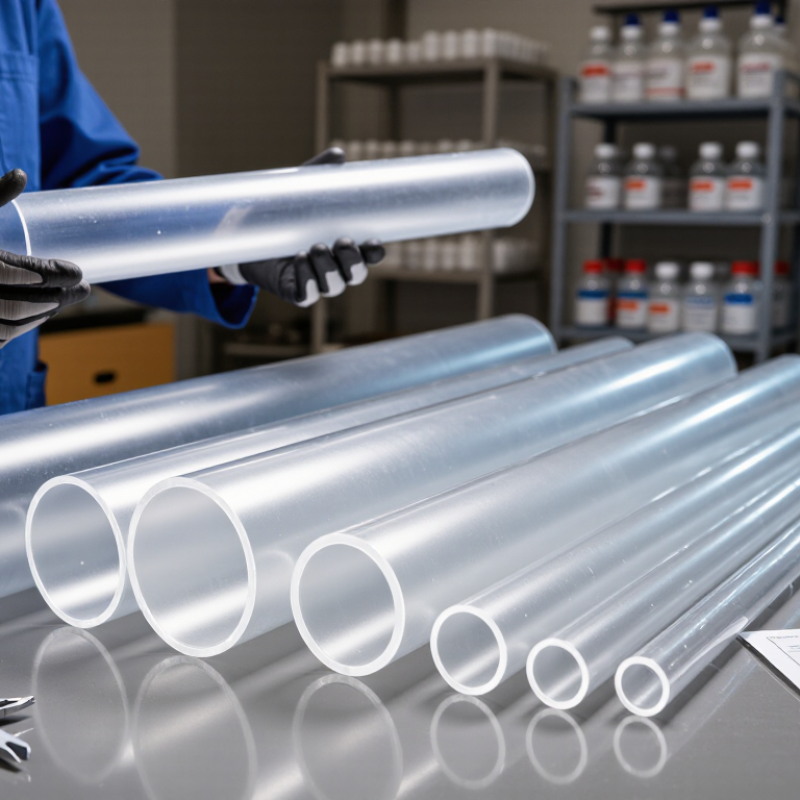
Choose a diameter that suits both the space available and the job the tube must do. Outside diameter determines how the tube fits into clamps or openings. Inside diameter matters when air, liquid, wiring, or another component needs to pass through. For example, a tube with a 25 mm outside diameter and a 3 mm wall has a 19 mm inside diameter. Check actual product dimensions before designing a close-fitting connection. Small differences matter.
Wall thickness affects stiffness and usable space inside the tube. A thicker wall can help resist bending under load, but it also reduces the inside diameter and adds weight. Consider how the tube will be supported, handled, and exposed to impact. A short, well-supported section may not need the same thickness as a long span. There is no universal best choice. I would still verify the load with a sample, especially when the tube will carry weight.
Length depends on the installation, support spacing, and cutting method. Measure the required span, then allow for end fittings or overlap where needed. Long unsupported tubes may sag, even when their walls seem substantial. Check the supplier’s available lengths and cutting tolerance before ordering. A careful measurement helps, but real assemblies can surprise you.
How to Choose the Right Polycarbonate Tube? — Select the Appropriate Diameter, Wall Thickness, and Length
Start with the tube’s outside diameter (OD), required inside diameter (ID), operating conditions, and finished length. The sizes below are practical examples for comparison, not universal stock sizes.
| Example OD |
Example Wall Thickness |
Calculated ID |
Example Cut Length |
Typical Selection Consideration |
| 20 mm |
2 mm |
16 mm |
300 mm |
Compact guards, small enclosures, or light-duty sleeves where a small internal opening is sufficient. |
| 25 mm |
2 mm |
21 mm |
500 mm |
A modest increase in clearance while keeping the tube relatively lightweight. |
| 32 mm |
3 mm |
26 mm |
600 mm |
A balanced example for protective covers or housings that need more wall material than a thin-wall tube. |
| 40 mm |
3 mm |
34 mm |
1,000 mm |
Useful when a larger clear opening is required; check support spacing if the tube will span between supports. |
| 50 mm |
4 mm |
42 mm |
1,000 mm |
A larger-bore example with a thicker wall; consider weight, fittings, and the load the tube must withstand. |
| 60 mm |
5 mm |
50 mm |
1,200 mm |
For applications needing a wide opening; verify handling, deflection, and end-connection requirements. |
Selection notes: ID is calculated as OD − (2 × wall thickness). Confirm actual dimensions, tolerances, available cut lengths, temperature limits, chemical compatibility, and load requirements with the supplier before specifying a tube. Polycarbonate tubing is not automatically suitable for pressure service.
Check Chemical, Temperature, and Environmental Compatibility
Start with the actual fluid, not a broad label such as “cleaner” or “oil.” Polycarbonate can tolerate some aqueous solutions yet react poorly to certain solvents, including aromatic hydrocarbons and strong alkalis. The exact formulation, concentration, contact time, and tube stress all matter. A tightly bent or firmly clamped tube may develop crazing sooner than an unstressed sample. Small details matter. Check chemical-resistance data for the specific tube grade, then test a short offcut under realistic conditions. Look for clouding, swelling, softening, fine cracks, or leakage; a quick wipe test is not enough. Test before scaling.
Temperature needs the same care. Compare expected continuous operating temperatures with the tube’s rated range, and include brief spikes during cleaning or hot-fluid transfer. Heat can reduce stiffness, while cold can make impact damage more likely. Consider outdoor exposure, UV, humidity, and repeated heating and cooling. A clear tube left near a sunny window may yellow or lose strength over time. Check whether UV stabilization is specified; clarity alone tells you little. Compatibility charts cannot reproduce every assembly or cleaning routine. I would rather trial a sample with the actual fittings and fluid than assume a published rating settles the question. That extra check may reveal a mismatch before installation.
Verify Standards, Fabrication Needs, and Supplier Specifications
How to Choose the Right Polycarbonate Tube?
Verify Standards, Fabrication Needs, and Supplier Specifications
Start by defining the conditions the tube must handle. Record its inner and outer diameters, wall thickness, operating temperature, and exposure to sunlight or chemicals. Then check which material standards or test methods apply to your project. A general claim such as “high impact” is not enough; ask for documented test results and clarify whether the stated values apply to the finished tube or only the raw material.
Consider fabrication before placing an order. Sawing, drilling, bending, and bonding can affect fit and performance. For example, a drilled hole near the tube’s edge may create stress, especially if the tool is dull or the part is tightly fastened. Ask the supplier for recommended machining limits, tolerances, and guidance on stress relief. Test a short sample using your actual tools. Small details matter.
Review the supplier’s specifications closely. Confirm dimensional tolerances, color consistency, surface finish, UV protection, and available inspection records. Ask whether each shipment can be linked to a material lot, and how defects or out-of-tolerance pieces are handled. A polished datasheet may still leave gaps. I’d check the details twice, particularly when the tube must fit existing fittings; that step is easy to overlook. Ask for proof.
How to Choose the Right Polycarbonate Tube
Suggested review emphasis for comparing tube options. These percentages are a practical planning guide, not a product standard or measured industry survey.
How to use it: Confirm applicable test standards and required properties, check that the tube suits your cutting, drilling, bending, or joining process, and verify dimensions, tolerances, and documentation with the supplier. Adjust the emphasis to suit your application.