China Top 10 Square Plastic Tubing Manufacturers

China is home to manufacturers serving a wide range of plastic extrusion needs, including square plastic tubing for furniture, displays, equipment, and construction projects. Yet suppliers can differ considerably in materials, production capacity, customization, and quality controls. A polished website alone does not show how consistently a tube holds its dimensions or finish.

This guide introduces ten China-based manufacturers and offers a practical starting point for comparing them. It considers product range, material options, custom sizing, manufacturing capabilities, and the information each company makes available. Buyers should also ask about tolerances, sample availability, lead times, packaging, and inspection procedures. Details matter. A square tube that looks suitable in a catalog may not fit a connector or withstand the conditions of its intended use.

The companies featured should be assessed against your own drawings, application, and order requirements. Where information is incomplete, direct confirmation is sensible; published claims are not a substitute for samples or technical documentation. This comparison is not a certification or a guarantee of performance. Supplier data may change, and some specifications require closer review. That can be inconvenient. It is also a useful reminder that choosing a manufacturer involves more than comparing prices. Clear communication and verifiable product details can help narrow the field before you request a quotation.
China Top 10 Square Plastic Tubing Manufacturers

Definition and Uses of Square Plastic Tubing

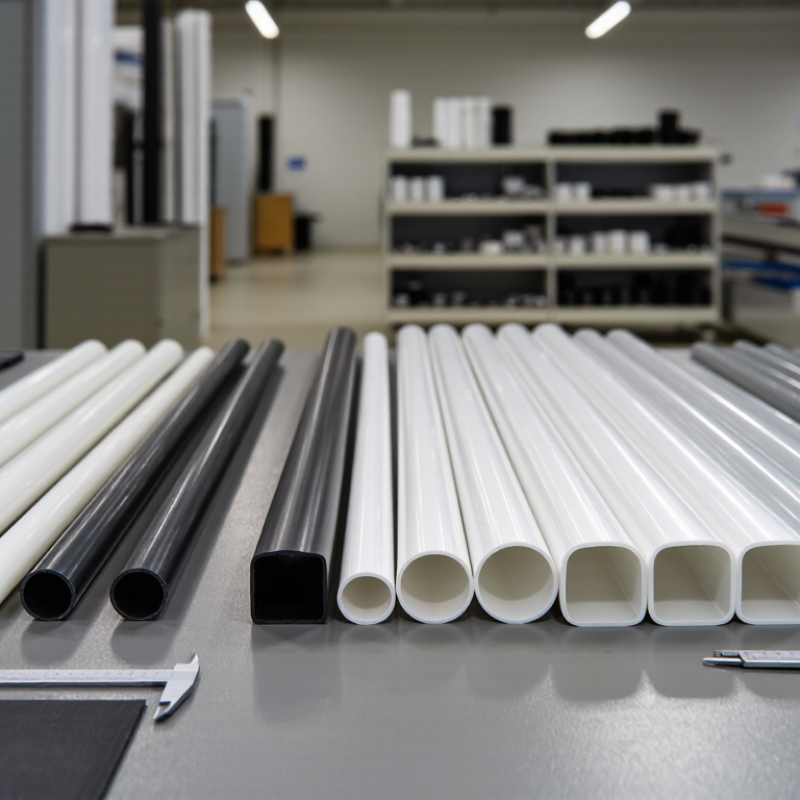
Square plastic tubing is a hollow profile with four sides, usually formed by extrusion. Its dimensions typically describe the outside width; wall thickness and corner radius determine the usable interior space. That distinction matters. Common materials include PVC, polyethylene, polypropylene, and ABS. Their stiffness, impact resistance, and temperature tolerance differ. A long tube can flex more than expected when left unsupported. Check span, load, temperature, chemical exposure, and sunlight before choosing a grade. Fit matters.

These tubes appear in lightweight frames, display stands, furniture components, equipment guards, and cable-routing channels. A square shape can sit neatly against flat surfaces and simplify alignment, but it does not guarantee high strength. For example, a thin-walled section may dent under a clamp, while an outdoor part may lose performance without suitable UV resistance. The OECD’s Global Plastics Outlook reports that global plastics production reached 460 million tonnes in 2019, and plastic waste totaled 353 million tonnes. These figures cover all plastics, not square tubing, but they make material choice and service life worth considering. Specifications sometimes omit corner radius or allowable load; those details deserve a second look before fabrication.

Definition: Square plastic tubing is a hollow extruded profile with a square or rectangular cross-section. It is used for lightweight frames, guards, supports, enclosures, and fluid-handling applications, depending on the polymer and product design.

About the chart: The bars show approximate density ranges for common tubing polymers in g/cm³. Actual values vary by grade, additives, and manufacturer; density alone does not determine whether a material is suitable for a particular use.

How China’s Square Plastic Tubing Industry Is Organized

China’s square plastic tubing industry is organized around specialized production stages rather than one uniform factory model. Material suppliers provide resin and color concentrates; extrusion plants melt, shape, cool, and cut the tubing. Some factories produce standard profiles in long runs, while others adjust dimensions, wall thickness, or surface finish for specific projects. A square tube may leave the line warm, pass through a calibration sleeve, then emerge beside a water-cooling trough. Small details matter. Uneven cooling can affect straightness.

Tooling and quality control connect these stages. Experienced producers check dimensions with gauges and inspect corners for distortion, especially when tubing must fit frames or sliding assemblies. Buyers often compare sample consistency, capacity, packaging, and delivery terms, not just price. Some suppliers handle cutting or drilling; others use local workshops for secondary processing. This creates flexibility, but can make responsibility less clear.

The industry is not perfectly standardized. “Square tubing” can describe products with different polymers, tolerances, and intended uses. Buyers should request a drawing, material specification, and repeatable inspection method before placing a large order. Even then, samples cannot reveal every production variation. That is worth remembering. The supply chain is efficient, but it still depends on communication—and that part is sometimes overlooked.

China Top 10 Square Plastic Tubing Manufacturers - How China’s Square Plastic Tubing Industry Is Organized
Industry Segment Common Material Typical Manufacturing Process Typical Product Focus Common Applications Key Quality Checks
General-purpose profile extruders Rigid PVC Profile extrusion through a shaped die, followed by cooling, sizing, cutting, and inspection Rigid square tubes and hollow profiles for indoor and outdoor use Construction trim, cable protection, furniture components, and display structures Outer dimensions, wall thickness, straightness, surface finish, and dimensional consistency
Polyolefin profile producers Polypropylene (PP) Thermoplastic profile extrusion with controlled cooling and haul-off Lightweight profiles with good chemical resistance Industrial equipment, packaging systems, laboratory fixtures, and general fabrication Dimensions, warpage, surface condition, and consistency between production runs
Outdoor and utility profile specialists High-density polyethylene (HDPE) Extrusion, cooling, sizing, and cut-to-length processing Tough, moisture-resistant square profiles and custom hollow sections Outdoor structures, agricultural equipment, protective components, and material handling Dimensions, impact-related performance, surface defects, and batch traceability
Consumer and fabrication profile suppliers Acrylonitrile butadiene styrene (ABS) Profile extrusion, with downstream cutting or machining when required Rigid profiles suited to appearance-focused or fabricated parts Appliance components, display systems, enclosures, and interior fittings Color uniformity, surface finish, dimensions, and corner or edge quality
Transparent and impact-resistant profile producers Polycarbonate (PC) Profile extrusion with close control of melt processing and cooling Clear or colored hollow profiles, subject to grade and design Lighting assemblies, protective covers, equipment guards, and display applications Optical appearance where relevant, dimensions, surface defects, and material consistency
Optical-grade profile specialists Polymethyl methacrylate (PMMA) Profile extrusion with controlled processing for appearance and clarity Transparent or translucent square profiles Lighting, signage, display fixtures, and decorative components Transparency, color, surface quality, dimensions, and protection against handling damage
Engineering-plastic profile producers Polyamide (PA, commonly called nylon) Engineering-plastic extrusion with material conditioning and controlled cooling Profiles for applications requiring wear resistance or mechanical performance Machinery, guides, rollers, and industrial components Dimensions, moisture-related dimensional change, surface condition, and grade traceability
Precision engineering profile suppliers Polyoxymethylene (POM) Precision profile extrusion followed by sizing and dimensional inspection Rigid profiles for accurately fitted mechanical parts Machine components, guides, fixtures, and sliding or moving assemblies Dimensional tolerances, straightness, surface finish, and consistency of the specified grade
Flexible-profile manufacturers Thermoplastic polyurethane (TPU) Flexible thermoplastic profile extrusion and controlled cooling Flexible or semi-flexible square tubing, depending on formulation and design Protective covers, cable-management components, seals, and industrial handling Dimensions, flexibility consistency, surface defects, and compatibility with the intended environment
Custom-compound and specialty profile producers Application-specific thermoplastics or filled compounds Custom extrusion using a specified resin or compound, die design, and process settings Profiles designed around customer requirements such as color, stiffness, or functional features OEM equipment, transport components, electrical assemblies, and specialized industrial uses Approved material specification, dimensional inspection, appearance, and documented batch control

Note: This table presents material-based supplier segments and common industry practices, not a verified ranking of individual manufacturers. Actual properties and suitability depend on the resin grade, formulation, profile design, and processing conditions.

Criteria for Comparing China’s Top 10 Manufacturers

Comparing China’s square plastic tubing manufacturers starts with a clear specification, not a low unit price. State the outside dimensions, wall thickness, length, polymer grade, color, and intended environment. Ask each supplier to quote against the same drawing. Check sample tubes with calipers at several points; corners can vary even when flat sides look consistent. Small differences matter. Request tolerance ranges and inspection records, then confirm how defects are handled. A useful comparison includes production capacity and tooling ownership, but capacity figures need context. Ask whether the quoted production line can maintain your volume without changing resin or process.

Material claims deserve careful checking. Request a technical data sheet and, where relevant, test results for impact, heat, UV exposure, or chemical contact. Verify that documents match the exact grade and color being quoted. A generic certificate may tell little. Review sample cut ends for voids, rough edges, and uneven walls, then test fit with your project’s connectors.

Also compare packaging, shipping dimensions, minimum order quantities, lead times, and payment terms. Ask how changes are approved and whether retained samples are available for production checks. Written answers help, but I would still verify key points on a pilot order. That step costs time. It can reveal gaps hidden by a neat quotation.

Profiles of 10 Leading Chinese Square Plastic Tubing Manufacturers

China’s square plastic tubing sector includes manufacturers with different materials, tooling, and production strengths. These ten profiles highlight useful differences rather than claim a strict ranking. One supplier may focus on rigid PVC tubing for cable protection. Another may extrude lightweight polyethylene sections for garden structures. A third may offer custom dimensions and color matching. Small details matter.

Other profiles include a manufacturer with broad standard-size inventory, a workshop specializing in short production runs, and a producer experienced with co-extruded tubing. One firm may emphasize smooth surface finishes for visible applications. Another may provide thicker walls for better resistance to bending. A further supplier could focus on recycled-content formulations, while the tenth may support sample development before larger orders. Capabilities vary, and published specifications should be checked against actual samples.

For buyers, useful questions include how closely outer dimensions are controlled, whether cut ends arrive clean, and how packaging prevents corner damage. Ask for material data, tolerances, and lead-time estimates in writing. A polished catalogue is not proof of consistent output. It is easy to miss that. These profiles work best as a starting point; application requirements, testing, and clear communication still shape a sound supplier choice.

How to Evaluate Suppliers, Materials, and Production Capabilities

China’s square plastic tubing suppliers should be evaluated on more than quoted price and catalogue dimensions. Request the polymer grade, wall-thickness tolerance, operating-temperature range, and evidence of batch traceability. Ask how production checks extrusion speed and cooling, since uneven cooling can leave a tube slightly bowed. Small details matter.

Plastics Europe’s Plastics—The Fast Facts 2024 reports global plastics production reached 413.8 million tonnes in 2023. That scale makes clear material identification and sourcing records worth checking, not assuming. Request a recent material certificate and a production sample. Measure a 25 × 25 mm section with calipers; inspect the corners, cut ends, and wall thickness. Ask whether the factory can reproduce the same dimensions across repeat orders, and request inspection records from different production runs. A clean sample is not proof. I would still want to see how rejected pieces are recorded, though supplier answers can be hard to compare without a shared checklist. Ask for equipment capacity, shift output, and realistic lead times, then compare those figures with your required order volume.