How to Choose the Right Plastic Tubing for Your Project?
Choosing the right plastic tubing can seem daunting. With many materials and sizes available, it's vital to make an informed decision. Plastic tubing is used in a variety of applications, from industrial uses to DIY projects.
Considerations come into play. Think about temperature resistance, flexibility, and pressure ratings. The choice impacts the overall functionality and lifespan of your project. A wrong selection can lead to issues. You might face leaks or improper flow, which can cause significant setbacks.
Take your time to assess your needs. Each project has unique demands. Visualize how the tubing will function and fit with other components. Research different types, like PVC or polyethylene. Be aware that every material has its pros and cons, which require careful thought. Ultimately, the right choice can elevate your project to success.
Understanding Different Types of Plastic Tubing: Key Characteristics
Choosing the right plastic tubing for your project requires understanding the diverse types available. Each type comes with its unique characteristics. For instance, polyethylene tubing is flexible and resistant to impact, while PVC tubing is rigid and offers excellent chemical resistance. Nylon tubing provides durability and flexibility in various applications, making it suitable for more demanding environments. Exploring these differences is crucial in making an informed decision.
Tips:
- Assess the specific requirements of your project. Will it be exposed to high temperatures or chemicals? These factors will affect your choice.
- Consider the environment. Certain types of tubing work better outdoors, while others are better for indoor settings.
Not all tubing is created equal. Reflect on what you need in relation to compatibility and durability. For example, you might favor a specific tubing type for its cost-effectiveness, but it may lack in durability under certain conditions.
In addition, the
diameter and
wall thickness of the tubing are also important. Thinner walls might be sufficient for light tasks, but for heavy-duty applications, thicker walls can provide the necessary strength. Always think about the long-term implications of your choice.
Evaluating Size and Diameter for Optimal Flow Performance
Choosing the right size and diameter in plastic tubing can significantly impact fluid flow. When evaluating your options, consider the application requirements. A narrower diameter may increase fluid velocity but could lead to pressure drops or blockages. Conversely, a wider diameter allows for smoother flow but might waste space and increase material costs.
Industry data suggests that tubing with diameters between 1/8 inch to 1 inch often provides optimal performance in many applications. For instance, a study from the Fluid Dynamics Institute shows that a diameter of ½ inch facilitates maximum flow rates in most standard systems. Understanding flow dynamics can ensure better fluid transport and efficiency in your project.
Tips: Always measure your existing setups accurately. Inaccuracies can lead to fitting issues, affecting overall performance. It's crucial to factor in potential flow variations. Ensure compatibility with the materials being transported, as chemical reactions can alter flow characteristics. Don't overlook the importance of testing different diameters before finalizing your choice. Adapting to specific conditions can make a significant difference in success.
Assessing Chemical Compatibility for Your Specific Application
When selecting plastic tubing, chemical compatibility is crucial. Each type of plastic interacts differently with various chemicals. Not all plastics will perform effectively in every environment. For example, polyvinyl chloride (PVC) may degrade when exposed to certain solvents. In industrial settings, approximately 20% of tubing failures are due to chemical incompatibility. This underscores the importance of thorough assessment.
Consider the specific chemicals your project will involve. Some plastics resist acids, while others are suitable for bases. According to industry reports, polyethylene is often favored in food applications because of its excellent chemical resistance. A mistake in choosing can lead to costly damage or safety hazards. Many users overlook the temperature impact on material integrity as well.
Do not forget to review compatibility charts. They can provide insights, but they aren't infallible. Testing small samples in real conditions is wise. Remember, what works for one application might fail for another. Be prepared for unexpected challenges.
How to Choose the Right Plastic Tubing for Your Project? - Assessing Chemical Compatibility for Your Specific Application
| Tubing Material |
Chemical Compatibility |
Temperature Range (°C) |
Common Applications |
| PVC |
Good for water, mild acids |
-10 to 60 |
Water distribution, drainage |
| Polyethylene |
Very good with many chemicals, poor with solvents |
-70 to 80 |
Food processing, chemical handling |
| PTFE |
Excellent resistance to chemicals |
-200 to 260 |
Pharmaceuticals, high-temperature applications |
| Nylon |
Excellent gas permeability, limited chemical resistance |
-40 to 100 |
Airlines, hydraulic applications |
| Silicone |
Good for food and medical applications |
-60 to 200 |
Medical devices, food processing |
Exploring Temperature Resistance to Ensure Longevity and Safety
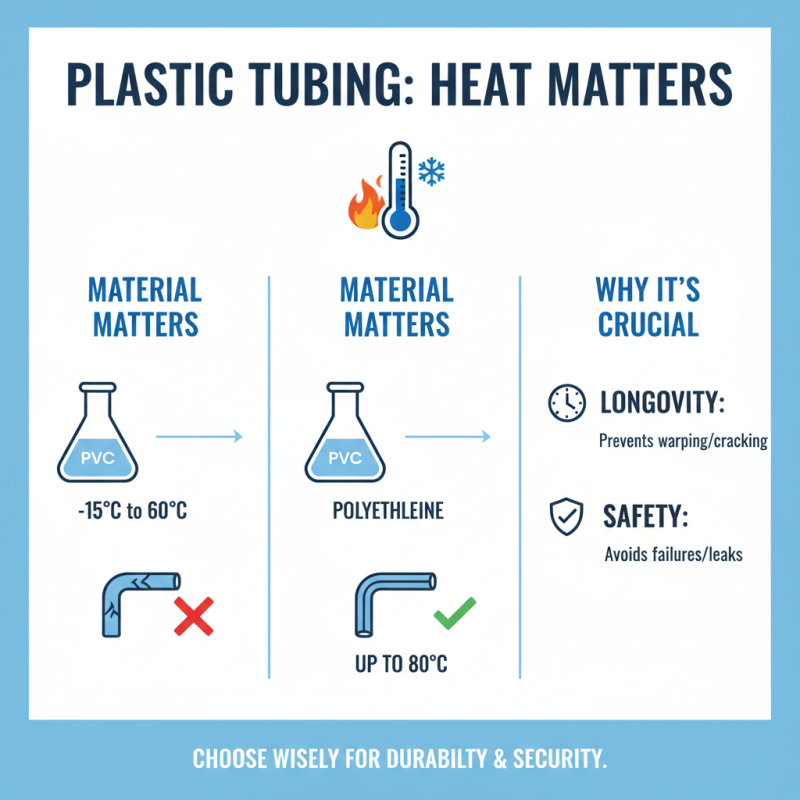
Choosing the right plastic tubing for your project involves understanding its temperature resistance. Different materials, like PVC and polyethylene, have distinct thermal properties. For example, PVC can handle temperatures from -15°C to 60°C, while polyethylene may withstand up to 80°C. This temperature range affects the tubing's longevity and safety. If the tubing can't manage the heat, it can warp or crack, leading to failures.
Tips: Always check the manufacturer’s specifications for maximum temperature limits. Testing your application is crucial. Subjecting the tubing to the intended environment can reveal possible weaknesses. Remember, prolonged exposure to high temperatures will reduce the material’s lifespan.
Consider real-world examples. A study showed that tubing exposed to elevated temperatures over time shrinks and becomes brittle. This deterioration might go unnoticed until it causes a leak or failure. In laboratory tests, materials with higher temperature thresholds significantly outperformed others.
Tips: Monitor the conditions your tubing will face. If you're unsure, consult with professionals. Sometimes the cheapest option isn't the best choice for temperature resistance. Scrutinizing material performance might save you from costly mistakes in the long run.