China Best Metallized Film Capacitor Manufacturers?
China has become a major production base for Metallized Film Capacitors used in power electronics, lighting, renewable energy, and electric vehicles. Supplier selection, however, requires more than comparing factory prices. The right manufacturer must demonstrate stable film quality, controlled metallization, accurate winding, and reliable sealing. Small defects can become visible later as capacitance drift, overheating, or shortened service life.
Industry data supports this growing demand. Mordor Intelligence’s Film Capacitors Market report identifies renewable energy, electric vehicles, and industrial automation as important growth areas. Grand View Research also links market expansion to rising inverter, power-supply, and energy-efficiency applications. These findings suggest strong opportunities for Chinese manufacturers, but market growth alone does not prove product reliability. A factory may have modern equipment. Its process discipline still needs verification.
Practical evaluation should include IEC 60384-based testing, insulation resistance checks, dissipation-factor measurements, self-healing performance, and life testing under heat and voltage stress. Ask for traceable test records, material specifications, production videos, and independent certification. Visit the plant if the project value justifies it. Check how operators handle metallized polypropylene film, edge margins, welding, and final inspection. No supplier wins every test. Even respected manufacturers may show uneven batch performance. Therefore, this guide compares leading Chinese manufacturers through technical capability, application experience, quality systems, customization support, export reliability, and after-sales communication. The ranking should be treated as a practical starting point, not an absolute verdict.
What Are Metallized Film Capacitors and How Do They Work?
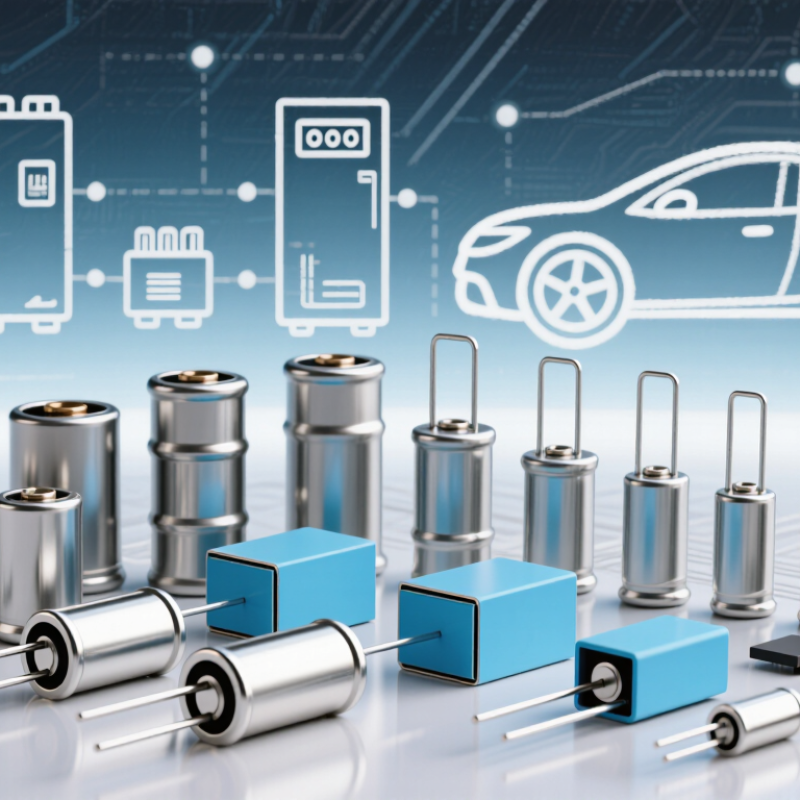
Metallized film capacitors use a thin plastic film as the dielectric. A microscopic aluminum or zinc layer is vacuum-deposited onto its surface. This conductive layer acts as an electrode. When voltage is applied, opposite charges gather on both sides of the film, creating an electric field and storing energy.
Their operation is simple, but the details matter. During AC filtering, the capacitor absorbs unwanted voltage fluctuations and releases energy during each cycle. If a tiny dielectric fault occurs, the surrounding metal layer can vaporize. This “self-healing” action isolates the defect and often preserves normal operation. The term can mislead. Self-healing is not unlimited, and repeated faults may reduce capacitance.
Grand View Research reported that the global film capacitor market was valued at several billion dollars in 2023, with steady growth expected through 2030. Applications include renewable-energy inverters, motor drives, lighting systems, and power-conversion equipment. IEC 60384 standards guide electrical and safety testing. Practical evaluation should include capacitance, dissipation factor, insulation resistance, pulse endurance, and thermal cycling. A reliable manufacturer should provide traceable test records, controlled film thickness, and clear operating-temperature ratings. These details matter more than attractive catalog figures.
What Are Metallized Film Capacitors and How Do They Work?
This chart shows the ideal capacitive reactance of a 1 µF metallized polypropylene film capacitor across frequency. The reactance is calculated using Xc = 1 / (2πfC). As frequency increases, capacitive reactance decreases, allowing alternating current to pass more easily. In practical components, ESR, lead inductance, temperature, and self-resonance also affect performance.
Which Manufacturing Standards Define China’s Best Capacitor Producers?
China’s best metallized film capacitor manufacturers are defined by controlled production, not attractive catalogs.
Their processes should align with relevant IEC 60384 requirements for electrical performance, safety, and endurance.
ISO 9001 supports consistent quality management, while automotive suppliers may require IATF 16949.
Compliance claims should include current certificates and test scopes.
Look closely at the factory floor.
High-quality producers control film thickness, tension, cleanliness, and metallization resistance during winding.
Each capacitor should carry traceable batch data.
Reliable laboratories test capacitance, dissipation factor, insulation resistance, self-healing behavior, and voltage endurance.
Thermal cycling and humidity tests reveal weaknesses that visual inspection misses.
Small details matter.
Good manufacturers also document incoming-film inspection and final sampling rules.
They should explain how rejected units are isolated, reviewed, and corrected.
That evidence is more valuable than a polished sales presentation.
However, standards alone cannot guarantee perfect performance.
A supplier may pass routine tests yet struggle with unusual pulse loads or long storage periods.
Buyers should compare test conditions with real operating environments.
Factory audits, sample evaluation, and independent verification remain necessary.
I would question any producer that promises zero failures.
Manufacturing is controlled, not magical.
How to Compare China’s Leading Metallized Film Capacitor Manufacturers
Choosing among China’s leading metallized film capacitor manufacturers requires more than comparing unit prices. Begin with the capacitor’s intended role, such as motor starting, power correction, filtering, or pulse discharge. Check capacitance tolerance, rated voltage, temperature range, loss factor, insulation resistance, and expected service life.
A reliable manufacturer should provide traceable test reports and clear production controls. Ask about raw film quality, metallization methods, winding tension, edge construction, and self-healing performance. Factory experience matters, but documented evidence matters more.
Review sample consistency across several batches, not just one attractive prototype. Confirm compliance with relevant international safety and quality requirements. A factory visit can reveal practical details, including humidity control, cleanliness, calibration records, and how rejected components are handled.
Tips:
Request samples with your actual operating conditions.
Test capacitance after heat, vibration, and voltage stress.
Compare the results with the supplier’s datasheet.
Speak with the engineering team, not only the sales contact.
A low quotation may hide thinner film, shorter life, or limited inspection. I have found that delivery reliability is often overlooked. Ask for production capacity, lead-time records, packaging protection, and replacement procedures.
Some comparisons still feel incomplete because buyers focus heavily on specifications and forget installation conditions. That gap deserves attention.
What Materials and Technologies Shape Capacitor Quality?
China Best Metallized Film Capacitor Manufacturers?
What Materials and Technologies Shape Capacitor Quality?
Metallized film capacitors are shaped by film quality, metal deposition, and winding accuracy. Polypropylene film offers low losses and stable performance in demanding circuits. Polyester tolerates higher temperatures but usually brings greater electrical losses. That choice is not cosmetic. Each polymer affects capacitance stability, insulation strength, and service life.
During production, vacuum-deposited aluminum or zinc forms the conductive layer. Metal thickness matters. Too much metal can reduce self-healing performance. Too little metal may increase resistance and heat. Controlled winding tension prevents wrinkles and air pockets. Clean edge margins also improve insulation between layers. Small defects can become serious under repeated voltage stress.
Segmented metallization helps limit damage when a weak point breaks down. The surrounding section disconnects, while the capacitor continues operating. Self-healing is useful, not magical. Repeated events can slowly reduce capacitance. Engineers should verify capacitance, dissipation factor, insulation resistance, and impulse behavior. Humidity testing reveals sealing weaknesses. Thermal cycling exposes stress between film, metal, and resin. Testing should follow applicable IEC requirements and documented production controls. In a real factory, traceability matters as much as elegant design. I would not judge quality from one sample alone. One batch may pass electrical checks yet age poorly in humid conditions. Better records, tighter process control, and honest failure analysis often reveal more than a polished specification sheet.
How Do Applications Determine the Right Chinese Manufacturer?
Application determines the right Chinese metallized film capacitor manufacturer more than catalog breadth. IEA’s Global EV Outlook 2024 reports over 14 million electric cars sold in 2023. This growth increases demand for compact DC-link capacitors with high ripple-current capability, low equivalent series resistance, and stable performance near 125°C. A supplier serving traction inverters should show thermal aging results, pulse testing, and traceable metallization controls.
Solar projects require a different evaluation. IEA PVPS Trends 2024 recorded more than 400 GW of global photovoltaic additions in 2023. Inverters therefore need capacitors that tolerate continuous voltage stress, humidity, and frequent thermal cycling. Ask Chinese manufacturers for self-healing data, partial-discharge testing, film thickness tolerances, and endurance results at the intended bus voltage. For AC filtering, appliance drives, and industrial equipment, capacitance stability and safety approvals may matter more than extreme energy density.
Do not choose by price alone.
In supplier audits, engineers sometimes compare capacitance first and overlook ripple current at real switching frequencies. That shortcut can produce excessive heating inside a small enclosure. Review sample construction, winding tension, spray-metal adhesion, and batch consistency. A capable manufacturer should provide controlled-process records, not only a polished datasheet. No selection rule is perfect. Application simulations, three-month pilot testing, and independent laboratory verification still expose weaknesses that factory claims may miss.
China Best Metallized Film Capacitor Manufacturers? - How Do Applications Determine the Right Chinese Manufacturer?
| Application | Primary Capacitor Function | Preferred Film Dielectric | Typical Electrical Range* | Important Construction Requirements | Manufacturer Capability to Verify | Relevant Standards or Tests |
|---|---|---|---|---|---|---|
| AC Motor Start and Run | Motor starting torque, phase shifting, and continuous reactive-power support | Polypropylene (PP) | Typically 250–500 VAC; approximately 1–100 µF, depending on motor size and duty cycle | Low loss, strong self-healing, pressure-interrupted safety design, and suitability for continuous AC operation | AC endurance testing, capacitance stability, dissipation-factor control, terminal strength, and production sealing consistency | IEC 60252-1; capacitance, voltage, endurance, self-healing, and safety-disconnector tests |
| Power-Factor Correction | Compensation of inductive reactive power in low- and medium-voltage networks | Metallized PP | Commonly 230–1,000 VAC; roughly 1–100 kVAr per capacitor unit | Low dielectric loss, controlled current density, discharge resistors, overpressure protection, and harmonic-current tolerance | Thermal design, partial-discharge control, hot-spot evaluation, harmonic-duty verification, and protection-device integration | IEC 60831-1 and IEC 60831-2; capacitance, loss angle, endurance, overvoltage, and destruction tests |
| DC-Link in Inverters and Solar Systems | DC-link energy buffering, ripple-current filtering, and voltage stabilization | High-temperature metallized PP | Approximately 600–1,500 VDC; capacitance commonly from several µF to several hundred µF | Very low ESL and ESR, high ripple-current capability, low inductive busbar layout, and long-life thermal design | Thermal-life modeling, ripple-current testing, humidity resistance, partial-discharge measurement, and low-inductance assembly | IEC 61071; DC voltage, ripple current, endurance, thermal stability, and self-healing evaluations |
| AC Filter and Motor Drive Output | Reduction of switching ripple, dv/dt, electromagnetic interference, and motor stress | Metallized PP | Typically 300–1,000 VAC; approximately 0.1–50 µF, with application-specific ripple current | High pulse-current capability, low loss at switching frequency, vibration-resistant terminals, and controlled parasitic inductance | Pulse-current endurance, frequency-dependent loss measurement, vibration testing, acoustic-noise review, and thermal derating data | IEC 61071 and applicable EMC requirements; pulse, endurance, insulation, and temperature-rise tests |
| EMI Suppression and AC-Line Filtering | Attenuation of common-mode and differential-mode interference on mains-connected equipment | Metallized PP or metallized PET, depending on temperature and safety class | Commonly 275–480 VAC; approximately 0.001–10 µF | Defined X or Y safety classification, flame-retardant encapsulation, controlled clearance and creepage, and fail-open behavior where required | Safety-agency documentation, lot traceability, flame testing, impulse testing, and automated insulation screening | IEC 60384-14; X1, X2, Y1, and Y2 classification tests, impulse voltage, damp-heat, and passive-flammability tests |
| Welding Equipment and Pulse Applications | Short-duration energy storage and delivery of high repetitive pulse currents | Heavy-edge metallized PP or segmented metallized PP | Often 500–2,000 VDC; capacitance selected from tens of µF to several mF | High peak-current tolerance, low ESL, robust spray metallization, strong end connection, and effective heat dissipation | Repetitive pulse testing, peak-current measurement, internal connection inspection, thermal cycling, and mechanical shock testing | IEC 61071 where applicable; manufacturer-defined pulse-life, insulation, temperature-rise, and mechanical tests |
| Electric Vehicle and Transportation Power Electronics | DC-link filtering and energy buffering in traction inverters, onboard chargers, and DC/DC converters | High-temperature metallized PP | Commonly 400–900 VDC; capacitance and ripple current depend on the power stage | High vibration resistance, low inductance, temperature capability commonly up to 105–125°C, and long electrical life | Automotive process control, high-temperature endurance, vibration and shock capability, humidity testing, and full traceability | AEC-Q200 may be requested for passive-component qualification; IEC 61071 and customer-specific transportation tests may also apply |
| Lighting Ballasts and LED Drivers | Power-factor correction, resonant control, ripple reduction, and input filtering | Metallized PP for higher temperature; metallized PET for compact, moderate-stress positions | Typically 250–630 VAC; approximately 0.01–20 µF | Compact winding, stable capacitance, low loss, flame-retardant encapsulation, and reliable operation under elevated ambient temperature | Temperature-rise evaluation, damp-heat testing, flame-retardant materials, capacitance tolerance control, and automated electrical inspection | IEC 60384-14 for safety capacitors and applicable LED-driver or lighting-equipment requirements |
| General Electronic Timing, Coupling, and Filtering | Signal coupling, timing, bypassing, and low-energy filtering | Metallized PET for compact, cost-sensitive designs; PP for lower loss and higher stability | Approximately 16–630 VDC; from nF values to several µF | Tight capacitance tolerance, stable dissipation factor, compact dimensions, and suitable lead or surface-mount termination | Automated capacitance and dissipation-factor measurement, insulation-resistance testing, dimensional control, and batch traceability | IEC 60384-1 and applicable sectional specifications for fixed capacitors |
*The electrical ranges are representative design ranges rather than universal product limits. Final selection should be based on rated voltage, RMS and peak current, switching frequency, ambient temperature, required service life, safety classification, mechanical constraints, and the applicable end-product standard.

