2026 Top Rigid Box Making Machine for Global Buyers?
In 2026, global buyers are looking beyond speed when selecting a Rigid Box Making Machine. They want stable quality, clear specifications, and dependable after-sales support. A premium machine should form sharp corners, apply paper smoothly, and maintain accurate dimensions across long production runs. Small errors become visible on luxury packaging.
Walter Soroka, a respected packaging technology expert, describes packaging as “the science, art, and technology of enclosing and protecting products.” That principle still matters. A Rigid Box Making Machine must protect the product while presenting a refined surface. Buyers should examine board compatibility, paper-feeding accuracy, glue control, forming pressure, and changeover time. These details often determine whether a machine performs well beyond the showroom.
This guide evaluates leading 2026 models for international purchasers. It considers output capacity, automation, energy use, operator safety, maintenance access, and technical service. Factory trials matter. Request sample boxes made with your actual paper, board, and adhesive. A machine that performs beautifully with one material may struggle with another. That uncomfortable truth deserves attention.
Not every expensive machine is the best choice. Not every fast machine delivers consistent boxes. Some buyers may also underestimate training, spare parts, and installation costs. Those weaknesses can disrupt production after delivery. The strongest choice balances measurable performance with practical support. This comparison aims to help manufacturers, converters, and packaging investors make a careful decision based on evidence, not impressive claims.
What Is a Rigid Box Making Machine?
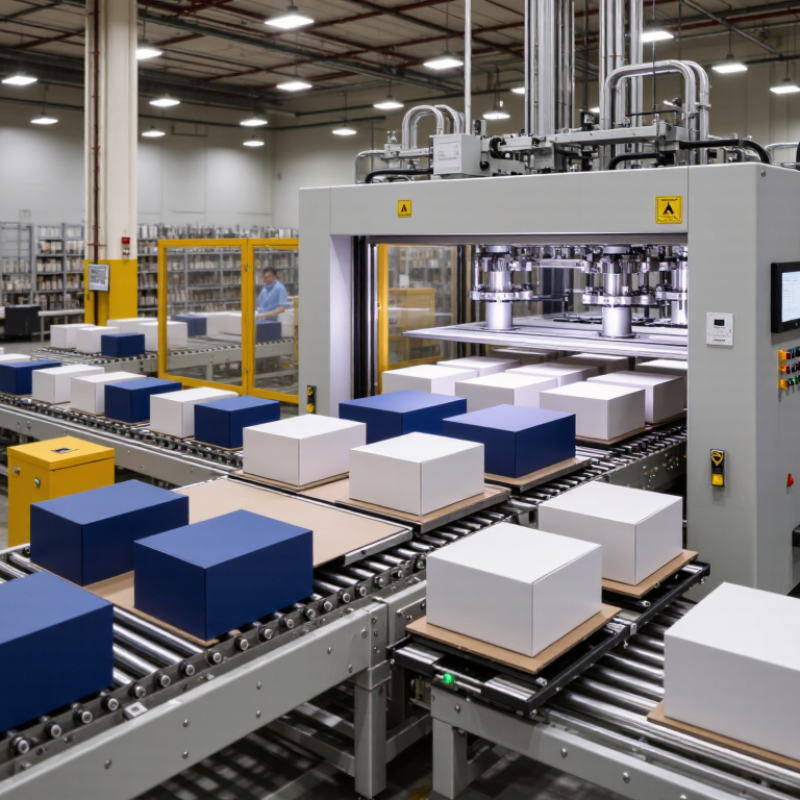
A rigid box making machine is industrial equipment that produces strong, premium-style boxes from greyboard, paper, and covering materials. It builds a fixed structure rather than a foldable carton. The machine usually handles board cutting, corner forming, gluing, wrapping, and pressing. Some models combine these stages in one production line. Others require manual feeding between stations.
The process begins with accurately cut board pieces. A positioning system places them around a base panel. Adhesive then bonds the joints and attaches the printed paper or fabric covering. Heated rollers or pressing plates remove air pockets and improve edge definition. Sensors can check material position, while adjustable guides support different box sizes. A skilled operator still matters. Small alignment errors can create visible gaps.
For global buyers, useful specifications include box dimensions, production speed, material thickness, changeover time, and glue compatibility. A machine should also provide stable pressure and repeatable positioning. High speed alone is not enough. In real production, complicated adjustments may reduce output. This detail is easy to overlook. Operators should test samples with the intended board and covering paper before purchase. Noise, maintenance access, spare parts, and training also deserve attention. No machine is perfect. Even advanced equipment may need hand correction for unusual shapes or delicate surfaces.
How Rigid Box Machines Turn Materials into Finished Packaging
2026 Top Rigid Box Making Machine for Global Buyers
How Rigid Box Machines Turn Materials into Finished Packaging
A rigid box machine begins with greyboard, printed paper, adhesive, and accurate measurements. The feeder positions each board sheet before cutting or creasing begins. Small alignment errors can create visible gaps at the corners. Good machines use sensors to check feeding, spacing, and board position. The operator still matters. Dust, humidity, and uneven paper can affect every result.
After cutting, the machine applies glue to selected areas and wraps paper around the board. Folding arms press the paper over edges and into corners. Corner-pasting units secure the joints, while forming tools shape the lid and base. A pressing section removes air pockets and helps the box keep its form. It is a physical transformation, not just an automated sequence.
The finished box may pass through drying, stacking, and visual inspection. Operators check surface bubbles, loose edges, crooked lids, and glue marks under bright light. A practical production line should support quick size changes and stable pressure control. Speed alone is not enough. I have seen fast equipment produce inconsistent corners when setup was rushed. That weakness deserves attention during trials. Buyers should test their actual board, paper, and adhesive before making a final decision. Temperature and humidity records also improve reliability over long production runs.
2026 Top Rigid Box Making Machine for Global Buyers? - How Rigid Box Machines Turn Materials into Finished Packaging
A practical comparison of common rigid box machine configurations, production capabilities, materials, and finished-packaging applications
| Machine Configuration | Main Production Function | Compatible Materials | Typical Box Size Range | Typical Output | Recommended Board Thickness | Best-Suited Box Types | Automation Level |
|---|---|---|---|---|---|---|---|
| Automatic Rigid Box Forming Machine | Applies adhesive, positions greyboard panels, folds wrapping paper, and forms the basic box structure. | Greyboard, duplex board, coated paper, art paper, linen paper, synthetic wrapping paper. | Approximately 50 × 50 mm to 400 × 300 mm, depending on tooling and machine design. | About 15–35 boxes per minute for standard formats. | Approximately 0.8–3.0 mm greyboard. | Book-style boxes, lid-and-base boxes, gift boxes, and standard set-up boxes. | High; suitable for continuous production with automatic feeding. |
| Rigid Box Corner Pasting Machine | Applies tape or adhesive to box corners and creates accurately squared tray or lid structures. | Greyboard, kraft paper tape, reinforced paper tape, hot-melt adhesive, water-based adhesive. | Commonly used for box widths of about 60–450 mm. | Approximately 10–25 boxes per minute, depending on corner count and adhesive method. | Approximately 1.0–3.5 mm greyboard. | Two-piece boxes, deep-draw trays, rigid lids, and heavy-duty presentation boxes. | Medium to high; automatic corner processing with operator loading on some systems. |
| Automatic Wrapping and Gluing Machine | Covers prepared board components with printed or decorative paper and folds the margins around the board. | Printed paper, coated paper, textured paper, fabric-like paper, recycled paper, and specialty laminates. | Approximately 60 × 60 mm to 500 × 350 mm working formats. | About 18–40 wrapped pieces per minute for repeatable box components. | Approximately 0.8–2.5 mm board, depending on fold geometry. | Book covers, box lids, drawer fronts, trays, and wrapped rigid panels. | High; well suited to repeat orders and standardized formats. |
| Rigid Drawer Box Assembly Machine | Forms the outer sleeve, assembles the inner drawer, and positions components for sliding-box construction. | Greyboard, coated paper, specialty paper, ribbon, foam inserts, and paperboard liners. | Typically 80 × 60 mm to 350 × 250 mm. | Approximately 8–20 complete drawer boxes per minute. | Approximately 1.0–2.5 mm greyboard. | Drawer boxes for cosmetics, jewelry, electronics, tea, confectionery, and premium gifts. | Medium to high; often configured as modular production cells. |
| Magnetic Closure Box Machine | Forms a folding or book-style rigid box and integrates magnets, straps, ribbons, or closure components. | Greyboard, printed paper, synthetic paper, magnets, ribbon, fabric, and decorative foils. | Approximately 80 × 60 mm to 450 × 350 mm. | About 5–15 finished boxes per minute, depending on insert and closure operations. | Approximately 1.2–3.0 mm greyboard. | Luxury gift boxes, watch boxes, perfume boxes, wine packaging, and electronics packaging. | Medium; additional manual or semi-automatic steps may be required for closures. |
| Automatic Box Lid and Base Machine | Produces separate lids and bases, aligns the two parts, and supports consistent clearance between components. | Greyboard, coated paper, offset-printed sheets, recycled paper, and laminated paper. | Approximately 50 × 50 mm to 450 × 350 mm. | Approximately 12–30 box sets per minute. | Approximately 0.8–3.0 mm greyboard. | Rigid gift boxes, food presentation boxes, apparel boxes, and general retail packaging. | High for standard dimensions; changeover time depends on tooling. |
| Special-Shape Rigid Box Machine | Processes custom contours, curved edges, irregular panels, or shaped components using dedicated fixtures. | Greyboard, paperboard, molded inserts, decorative paper, fabric, and laminated coverings. | Project-specific; commonly below 400 × 300 mm for complex shapes. | Approximately 3–12 boxes per minute, depending on shape complexity. | Approximately 1.0–2.5 mm board. | Custom promotional boxes, shaped cosmetic boxes, novelty packaging, and premium product sets. | Low to medium; frequently uses special tooling and skilled setup. |
| Rigid Box Line with Vision Inspection | Combines forming, wrapping, gluing, conveying, and camera-based inspection for production quality control. | Greyboard, coated paper, printed paper, recycled board, specialty paper, and laminated coverings. | Commonly 60 × 60 mm to 500 × 400 mm, subject to line configuration. | Approximately 20–45 boxes per minute for standardized products. | Approximately 0.8–3.0 mm greyboard. | High-volume packaging for cosmetics, consumer electronics, confectionery, and gift products. | Very high; suitable for integrated production, monitoring, and reject handling. |
Data note: The figures shown are typical industry operating ranges for rigid box production equipment. Actual output, size limits, board compatibility, adhesive performance, and automation level vary according to box structure, material properties, tooling, operator workflow, and quality requirements.
Main Types of Rigid Box Making Machines and Their Uses
For global buyers in 2026, rigid box making machines are available in several practical types. Each type serves a different production need. Choosing by output alone can create costly mistakes.
Automatic Rigid Box Making Machines suit large factories producing consistent box sizes. They can handle paperboard feeding, gluing, wrapping, and forming with limited operator input. These machines work well for gift boxes, electronics packaging, and premium retail packaging. Their strengths include speed and repeatable alignment. However, they need accurate settings and regular maintenance. A small feeding error can affect hundreds of boxes.
Semi-automatic machines offer more flexibility for varied orders. Operators may position greyboard, adjust paper, or complete special folding steps by hand. They are useful for small and medium workshops with frequent size changes. Corner pasting machines focus on forming strong box corners before wrapping. They are valuable for drawer boxes, book-style boxes, and rigid trays. Box wrapping machines apply printed paper around the formed structure. Some models support different paper weights and surface finishes. That matters when packaging has delicate textures.
Multifunction machines combine several operations and can reduce floor space. They may also require longer setup time. Buyers should inspect real samples, board thickness, changeover speed, and waste rates before ordering. Technical manuals, operator training, spare-part access, and local safety compliance deserve equal attention. In practice, the fastest machine is not always the most reliable choice. Forecasts can be wrong. A balanced machine may perform better when orders change suddenly.
2026 Top Rigid Box Making Machine for Global Buyers
Main types of rigid box making machines and their typical applications. The throughput ranges are indicative industry values for standard production conditions; actual output varies with box size, material, automation level, changeover time, and operator experience.
How to Choose the Best Rigid Box Machine in 2026
Choosing a rigid box machine requires more than comparing production speed. Examine the complete workflow, from board feeding to finished wrapping. The machine should handle your common box sizes, board thicknesses, paper types, and corner structures. Ask for test samples using your actual materials. A sample made with different paper can hide alignment problems.
Check positioning accuracy, glue control, pressing pressure, and drying stability. Small errors become visible on luxury packaging, especially around corners and lid gaps. Measure twice.
Review the machine’s adjustment time between orders. A fast machine that takes an hour to change formats may reduce daily output. Request documented tolerances, electrical requirements, safety features, and maintenance intervals.
Operator access matters. Clear controls, guarded moving parts, and simple cleaning procedures reduce avoidable downtime. Confirm whether replacement components are available in your region. Training quality is equally important, but it is often overlooked during purchasing. Ask for installation guidance, troubleshooting records, and realistic response times.
Do not rely only on impressive videos. Noise matters. So does waste. A machine may appear efficient while consuming excessive paper during setup. I would also inspect a running unit personally when possible. Specifications can mislead, and even experienced buyers sometimes prioritize speed over consistency. A careful evaluation should include production trials, operator feedback, and several weeks of expected workload.
Global Buying Factors: Quality, Cost, Compliance, and Support
For global buyers, a rigid box making machine must deliver more than attractive output. Quality appears in small details: accurate board alignment, even glue coverage, stable folding, and clean corners. During a factory trial, inspect several box sizes, not just one successful sample. Check the first box and the fiftieth. Production reality is less forgiving.
Cost should include energy use, tooling, maintenance, labor, material waste, and downtime. A low purchase price may hide expensive adjustments later. Ask for cycle-time data under realistic conditions. Request samples using your own board, paper, and adhesive. They reveal more than a polished demonstration. No machine is perfect. I still allow a practical margin for setup errors and operator learning.
Compliance requires careful verification before shipment. Review electrical documents, safety guards, emergency stops, manuals, and installation requirements for the destination country. Do not rely on a generic certificate without checking its scope. Support matters just as much after delivery. Confirm spare-part availability, remote diagnostics, training, response times, and local service options. A clear troubleshooting guide can save hours when glue temperature drifts or folding pressure changes. Buyers should record every promise in the contract. Verbal confidence is useful, but documented support is safer.

